

National Parks and wildlife sanctuaries are two protected regions in India that have been established to preserve the biodiversity of India. National Parks and wildlife sanctuaries both ensure a secure habitat for wild animals, birds, plants, and other organisms, but the regulations and degree of protection may differ from one another. The difference between a national park and a wildlife sanctuary lies in the degree of protection and activities allowed within the protected region.
While national parks are more strict about the degree of protection and focus more on conserving the entire ecosystem including wildlife, forests, landscapes, and habitats, wildlife sanctuaries only focus on protecting wild animals and their habitats, allowing certain regulated human activities within. The knowledge of the above difference is useful for students, wildlife lovers, tourists, and everyone else interested in environmental preservation.
What Is a National Park?
National parks are protected zones where the preservation of flora, fauna, natural scenery, and ecosystems is the primary objective. These national parks receive strong legal protection, and no actions that might prove harmful to the environment are allowed within these zones.
National parks aim at preserving nature in its natural state. Here, one can find protection for all kinds of living organisms, right from big animals like tigers and elephants to different types of trees, shrubs, and grasses. Some well-known national parks of India are Jim Corbett National Park, Kaziranga National Park, Kanha National Park, and Ranthambore National Park.
Main Purpose of a National Park
The main reasons for creating a national park are as follows:
- Protection of wildlife and habitats
- Biodiversity conservation
- Protection of vital ecosystems
- Prevention of hunting and other activities that harm the environment
- Protection of forests, landscapes, and natural resources
- Promotion of scientific research and environmental education
- Provision of guided wildlife tours
Thus, the creation of a national park is not about one particular species of animals but an ecosystem as a whole.
Features of National Parks
National parks have distinct boundaries and operate on strict conservation rules.
Among some of the characteristics are:
- Strong degree of protection: The species and their habitat enjoy strong legal protection.
- Restriction of human activities: Human activities that may cause destruction to the environment are either not allowed or strictly regulated.
- Protection of ecosystems: Ecosystems like forests, savannas, wetlands, mountains, rivers, and species are all protectable.
- Controlled tourism: Tourists have access to the national park through specified routes.
- Focus on conservation in management: Conservation is the main goal of management in national parks.
What Is a Wildlife Sanctuary?
A wildlife sanctuary is an area which has been conserved primarily to preserve the wild animals along with their habitat. This provides a safe environment for the existence, breeding, and maintenance of the wild animal population.
In comparison to a national park, a wildlife sanctuary may have some flexibility in human activities according to the sanctuary in question. Wildlife sanctuaries may be set up for the preservation of certain wildlife species or groups, certain habitats, or migratory birds.
Main Purpose of a Wildlife Sanctuary
Some of the main objectives of wildlife sanctuaries are:
- To protect wild animals from hunting and exploitation
- Conservation of significant wildlife habitats
- Protection of endangered and threatened species
- Biodiversity
- Wildlife research and conservation efforts
- Breeding grounds for wildlife
- Responsible tourism for nature and wildlife
Hence, it can be seen that a wildlife sanctuary can be useful in the protection of wildlife even if the location does not have all the restrictions like a national park.
Features of Wildlife Sanctuaries
Some of the typical characteristics of wildlife sanctuaries may be:
- Protection of wild animals and their natural habitat
- Prohibition of hunting and other activities that can harm wildlife
- Controlled entry and tourism
- Permissibility of some human activities
- Protection of breeding and feeding grounds
- Wildlife conservation projects
As far as the specific regulations vary from sanctuary to sanctuary, it is necessary to obey the regulations set by the respective authorities.
National Park vs Wildlife Sanctuary: Key Differences
Both national parks and wildlife sanctuaries are protected areas; however, these two types of protected areas differ from each other in respect of their objectives, level of protection, presence of human activities, and management regulations. While national parks provide better protection to the entire ecosystem, wildlife sanctuaries mainly aim at safeguarding wildlife and its habitat.
Difference in Level of Protection
The national park provides more protection than that of the wildlife sanctuary. The main aim is the conservation of the natural habitat, flora, fauna, and ecosystem processes. There is a provision for wildlife sanctuaries for legal protection of wildlife. Certain regulated uses or pre-existing rights can be allowed in specific sanctuaries according to the regulations.
Difference in Human Activities
Human activity is controlled in greater numbers within national parks. Human activities which may cause disturbance to wildlife and destroy plants and their habitat are not allowed. On the other hand, there might be some activities that are allowed within wildlife sanctuaries, provided they meet certain conditions. But those activities which threaten the wildlife and habitat are restricted.
Difference in Grazing and Resource Use
The activities of grazing and utilization of forest products are more restricted in case of national parks. In a wildlife sanctuary, there can be some of the activities which are already going on or permitted by the government for that particular region.
Difference in Private Rights
Private rights and human activity are more restricted by national parks than they are by wildlife sanctuaries. There are some existing rights that can be maintained in wildlife sanctuaries despite the applicable law or rules. This is why there is usually some flexibility within sanctuaries compared to national parks.
Difference in Tourism and Visitor Access
Tourists can visit both national parks and wildlife sanctuaries, but their access is controlled. There will normally be specific areas for tourism activities like safaris and nature walks in national parks. Such activities are possible in wildlife sanctuaries too, where there might also be specific areas for bird watching and so on. It is essential that visitors respect rules meant to disturb the animals as little as possible.
Difference in Wildlife and Ecosystem Protection
National parks aim at conservation of the complete natural ecosystem, which consists of animals, birds, plants, forests, water bodies, landscapes, and ecology. On the other hand, wildlife sanctuaries are mainly dedicated to the conservation of wildlife and their habitats. However, certain sanctuaries may be highly significant from the conservation point of view of specific species of animals.
National Park and Wildlife Sanctuary Difference Table
| Basis | National Park | Wildlife Sanctuary |
|---|---|---|
| Primary Objective | Conservation of the overall ecosystem | Protection of wildlife and their habitats |
| Protection Level | Generally stricter | Strong but comparatively flexible |
| Human Activities | Highly restricted | Certain regulated activities may be permitted |
| Grazing | Generally prohibited/restricted | May be permitted under specific conditions |
| Resource Use | Highly restricted | May be allowed in limited regulated circumstances |
| Private Rights | More strictly restricted | Certain existing rights may continue |
| Tourism | Allowed in designated areas | Allowed under applicable regulations |
| Focus | Wildlife, flora, habitat and ecosystem | Wildlife and habitat |
| Management | Strong emphasis on ecosystem conservation | Strong emphasis on wildlife conservation |
| Legal Protection | High level of protection | High level of protection, with some flexibility |
Which Has More Protection: National Park or Wildlife Sanctuary?
Usually, national parks provide more protected areas than the wildlife sanctuaries. The national park must aim at protecting the ecosystem with the least interference from humans. The wildlife sanctuary can provide good protection too, but there may be some regulated human activity allowed in accordance with the rules.
Can People Live in National Parks and Wildlife Sanctuaries?
The conditions concerning the presence of humans vary depending on whether it is a national park or a wildlife sanctuary. National parks tend to impose strict limitations when it comes to the presence of human inhabitants, whereas wildlife sanctuaries may have some pre-existing rights or settlements.
Human Settlement in National Parks
Management of the national parks is mainly with respect to protection of wildlife and natural ecosystems. Human activities that tend to hinder conservation goals are often discouraged.
There are instances where rights or settlements can be handled through legal means like relocation of rights or settling rights when the area is classified as a national park. This all depends on the particular national park and the laws governing it.
Human Settlement in Wildlife Sanctuaries
Village areas can also be included in the wildlife sanctuaries, if so provided by the way the protected area has been created and according to regulations. But those living inside or near the wildlife sanctuary need to abide by the limitations in place for wildlife conservation. Activities that can greatly harm the natural habitat of the wildlife may be banned or regulated
Can You Visit a National Park and Wildlife Sanctuary?
Indeed, both national parks and wildlife sanctuaries are accessible to tourists, nature lovers, photographers, researchers, and wildlife enthusiasts. Nevertheless, it is important for visitors to observe the set regulations that have been put in place by the authorities of forests and wildlife.
Some of the standard visitor guidelines may include the following:
- Use authorized entry gates only
- Take designated trails
- Do not feed wild animals
- Maintain a safe distance from wildlife
- Minimize noise levels
- Do not litter
- Do not harm flora and fauna
- Abide by photography guidelines if any
- Follow vehicle/safari guidelines
Tourism usually takes into consideration the need for people to enjoy nature while minimizing disturbance to the wildlife.
Examples of National Parks in India
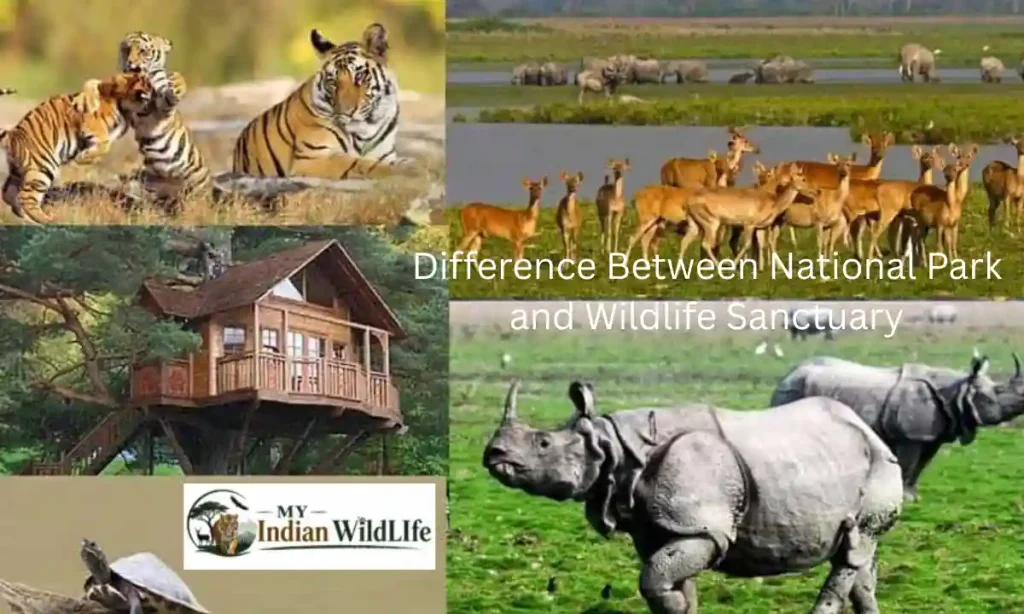
India has a vast array of national parks in different geographical locations. Such reserves preserve a number of various ecosystems and species of wild animals.
Jim Corbett National Park
Situated in Uttarakhand, Jim Corbett is one of the most famous national parks in India. The park is very famous for its tigers and the forest ecosystem.
Kaziranga National Park
Kaziranga is a national park in Assam famous for its one-horned rhino. Besides rhinos, it is also home to other animals like elephants, wild buffaloes, swamp deer, and several birds.
Kanha National Park
Madhya Pradesh’s Kanha is famous for its forests, grasslands, and wildlife. It serves as a habitat for various animals like the tiger and others.
Ranthambore National Park
Located in Rajasthan, Ranthambore is famous for its tigers and offers a combination of dry forests, grasslands, lakes, and historic surroundings.
Examples of Wildlife Sanctuaries in India
Wildlife sanctuaries are present all over India, which safeguard various animals and their habitats.
Asola Bhatti Wildlife Sanctuary
Asola Bhatti Wildlife Sanctuary is an environmental zone in Delhi. It is one of the wildlife zones in the National Capital Region. It is a part of Southern Ridge where there are different kinds of birds, mammals, reptiles, and native flora.
Indian Wild Ass Sanctuary
Indian Wild Ass Sanctuary in Gujarat is home to the Indian wild ass, which is locally known as the ghudkhar. The sanctuary includes the unique terrain of the Little Rann of Kutch.
Ranganathittu Bird Sanctuary
Ranganathittu is located in Karnataka and is famous for its wetlands and bird life. It serves as a habitat for both resident and migratory birds.
Periyar Wildlife Sanctuary
Periyar, located in Kerala, is renowned for its forests and lakes and is home to animals like elephants, tigers, gaur, and many kinds of birds and wildlife.
Importance of National Parks and Wildlife Sanctuaries
Both types of protected areas have a significant contribution to ecological balance in conservation of nature heritage of India.
Wildlife Conservation
Protected areas ensure that wild animals have safe havens where they can feed, mate, and live without human interference.
Protection of Natural Habitats
Ecosystems such as forests, swamps, grasslands, rivers, etc., can be safeguarded from human actions that contribute to habitat degradation.
Biodiversity Conservation
National Parks and Wildlife Sanctuaries are effective means to conserve various kinds of animals, birds, plants, insects, and microorganisms in their native surroundings.
Environmental Protection
Healthy ecosystems help provide clean air, water conservation, soil conservation, carbon sequestration, and many other ecological services.
Eco-Tourism and Education
Responsible Tourism enables tourists to understand about the wildlife and nature, thereby developing an awareness for conservation.
National Park vs Wildlife Sanctuary: Which Is Better for Wildlife Protection?
It is hard to claim either of them to be “better” because both of them play an important role in conservation. National parks are usually more protective and provide more appropriate conservation of ecosystems without any human impact.
Wildlife sanctuaries may prove to be very efficient when it comes to the protection of vital habitats for wildlife and regulation of some activity. What really matters is not the type of the territory, but how efficiently it is being managed and protected.
Why Are National Parks and Wildlife Sanctuaries Important?
Protected areas like national parks and wildlife sanctuaries play a crucial role in the preservation of wildlife. This is because these areas offer safe zones for various organisms to live within their natural habitat. There are diverse types of ecosystems in India, including those that include the Himalayan forests, tropical rainforests, grasslands, wetlands, deserts, and coastal zones.
Protection of Endangered Species
The protected areas make the environment safe for endangered animals. The restrictions of hunting, habitat destruction, and other activities that harm the animals allow their population to thrive.
Protection of Forests and Vegetation
National parks and reserves serve to conserve forests, grasslands, shrubs, swamps, and other natural plant life. They are sources of food, shelter, and breeding ground for the wild animals.
Maintaining Ecological Balance
Each species has its own part to play in the ecosystem. Predators regulate prey populations, herbivores affect plants, and birds and insects assist in pollination and seed dispersal. Conserving these relationships ensures ecological balance
Supporting Scientific Research
Protected areas offer excellent research chances for scientists to study wildlife, forestry, diversity, animal behavior, weather patterns, and ecological changes. Research can help authorities formulate better conservation strategies
Difference in Management Approach
While both national parks and wildlife sanctuaries are protected areas, they may use different management styles.
Management of National Parks
Management mostly concentrates on ensuring that the natural ecosystem is preserved without disturbing any of the wildlife or modifying their habitat. Tourism may be regulated, visitors’ facilities may be established, habitats protected, poaching prevented, and wildlife populations monitored.
Management of Wildlife Sanctuaries
The management of wildlife sanctuaries revolves around wildlife and habitat conservation issues. Depending on the specific sanctuary in question, the management may have to manage people’s access and activities such as cattle ranching. Thus, the management issues become variable for each sanctuary.
National Park vs Wildlife Sanctuary for Tourism
However, both national parks and wildlife sanctuaries offer great places to enjoy nature and wildlife tourism.
Wildlife Safari
Jeep safaris and other safaris are arranged by many national parks. This is because visitors get to see wild animals while staying on marked routes. Safari and vehicle-based wildlife viewing trips may also be arranged in some wildlife sanctuaries.
Birdwatching
Wildlife sanctuaries, especially wetlands and forest reserves, make ideal spots for bird-watching. The visitors may get to see both the resident birds and the migratory birds.
Nature Walks
However, some protected areas have trails marked for walking or natural interpretation zones. Visitors should use only the permitted paths.
Wildlife Photography
Photography is one of the common activities carried out in protected areas. Nevertheless, one must keep a safe distance from the wildlife to capture a good photo.
Rules Visitors Should Follow
While going to a national park or wildlife sanctuary, it becomes important to behave responsibly.
- Do not give food to wild animals.
- Do not try to come close to or touch any kind of wildlife.
- Make sure there is no loud noise.
- Do not litter.
- Follow the designated paths only.
- Obey the guidelines of the forest officers and guides.
- Do not take away any plant, rock, feather, or other natural substance.
- Do not use flash photography where it is forbidden.
- Do not play loud music in the protected area.
- Do not try to lure animals for photography purposes.
These precautions will serve to help visitors and wildlife equally.
How to Reach National Parks and Wildlife Sanctuaries
These national parks and wildlife sanctuaries exist in various geographical regions within India, hence the availability of these parks is determined by the geographical locations where these national parks and wildlife sanctuaries are found. Most of these parks are accessible via road, rail, or air transport to the gate.
How to Reach by Road
Road travel is perhaps one of the most convenient means of getting to national parks and wildlife reserves. Most conservation areas are well connected with adjacent cities or towns via highways and local roads. Travelers can make use of any personal car, taxi, bus, and other forms of local transportation. In case of remote locations of wildlife, the latter part of the journey may include use of a local taxi.
How to Reach by Train
The use of trains is another alternative in case the conservation area is situated near a railway station. Visitors can first travel to the nearest major or minor railway station and then move ahead to the destination via a taxi, bus, or car. The distance from the railway station to the park or wildlife sanctuary may differ a lot; therefore, visitors need to find out about the exact entry point.
How to Reach by Air
Flying into the nearest airport is advantageous for people coming from far-off places since this will reduce travel time. Once you arrive at the airport, local transport can be availed to get to the sanctuary site. A number of renowned national parks and sanctuaries are located far off from the nearest airports, making the road journey a necessity.
Local Transport to the Entry Gate
The journey to the nearest city or even transport station will not necessarily be an indication that you have reached your destination of the protected area. Most of the protected areas have their own entry points. There will be a requirement for visitors to use some kind of transport means to get to the entry point.
Important Things to Check Before Travelling
Before going to any national park or sanctuary, you should check for:
- The nearest airport and railway station
- The distance of the nearest city
- Road transportation available
- Entrance gates
- Hours of opening of the park/sanctuary
- Availability of safari/vehicle
- Permit and entry requirements
- Accessibility of the place during that season
- Weather conditions
Best Way to Reach a National Park or Wildlife Sanctuary
However, there isn’t one ideal mode of transport that suits all protected areas. Road transport is usually the most convenient one for the last leg of the journey whereas train and air transport can prove helpful to reach the nearby city or transport center. It all depends on the protected area itself as well as its location, distance, financial considerations, and the transportation facilities available there.
Sanctuaries Wildlife and Parks National of Location & Google Maps
National Park vs Wildlife Sanctuary: Which One Should You Visit?
This will depend on what you are looking for. In case you are looking for experiences in relation to ecosystem conservation on a broad scale, safaris, forests, and animals, then a national park will be a good option for you. On the other hand, if you are more interested in bird watching, particular species, wetlands, and nature, then a wildlife sanctuary will work out equally well for you.
National Park vs Wildlife Sanctuary: Quick Summary
Some differences to keep in mind can be illustrated by the following comparisons:
- National Park: More protection is offered for the whole ecosystem.
- Wildlife Sanctuary: The protection is geared towards wildlife and habitats.
- National Park: More restrictions on human activities.
- Wildlife Sanctuary: Some controlled activities or prior rights can be allowed.
- National Park: There is more consideration for maintaining the ecosystem in its natural state.
- Wildlife Sanctuary: More leeway in certain management cases.
- Both: Wildlife, habitats, biodiversity, and natural resources are protected.
- Both: Allow tourism, learning, and research.
Conclusion
National parks and wildlife sanctuaries both play significant roles in conservation of India’s natural environment. The key difference lies in the fact that national parks offer strict protection to the entire eco system whereas wildlife sanctuaries offer protection mainly to wildlife and its habitat along with some relaxation in regulations.
Neither of them can be considered unimportant. Efficient management, habitat preservation, wildlife surveillance, enforcement of laws and regulations, and responsible tourism are absolutely crucial for success of both of them. The only rule for tourists is quite clear – appreciate nature without disturbing it. Thus the protected territories can stay safe for wildlife while future generations can see the same nature.
Faqs
What is the main difference between a national park and a wildlife sanctuary?
A national park generally provides stricter protection to the entire ecosystem, while a wildlife sanctuary primarily focuses on protecting wildlife and their habitats.
Which has stricter rules, a national park or a wildlife sanctuary?
National parks generally have stricter rules and greater restrictions on human activities, resource use, and habitat disturbance.
What is the main purpose of a national park?
The main purpose of a national park is to protect wildlife, plants, habitats, landscapes, and the overall ecosystem from harmful human activities.
What is the main purpose of a wildlife sanctuary?
A wildlife sanctuary is mainly established to protect wild animals and their habitats and provide them with a safe environment for survival and reproduction.
Can people live inside a wildlife sanctuary?
In some wildlife sanctuaries, villages or certain existing rights may continue subject to applicable laws and regulations. The situation differs from one sanctuary to another.
Can people live inside a national park?
Human settlements and rights inside national parks are subject to the applicable legal framework. National parks generally impose stronger restrictions on habitation and human activities.
Is tourism allowed in national parks and wildlife sanctuaries?
Yes, tourism can be allowed in both. Visitors must follow the rules of the respective protected area and generally remain within designated tourism zones or routes.
Is grazing allowed in national parks and wildlife sanctuaries?
Grazing is generally more restricted in national parks. In some wildlife sanctuaries, it may be permitted under specific conditions and applicable regulations.
Which is better for wildlife conservation: a national park or a wildlife sanctuary?
Both are important for wildlife conservation. National parks generally provide stricter ecosystem protection, while sanctuaries can protect important species and habitats under a somewhat more flexible management framework.
Why are national parks and wildlife sanctuaries important?
Both help conserve wildlife, biodiversity, forests, wetlands, grasslands, and natural habitats. They also support scientific research, environmental education, and responsible wildlife tourism.
Also,Read About: Barnawapara Wildlife Sanctuary: Timings, Safari, Entry Fee, Location & Things to Do