
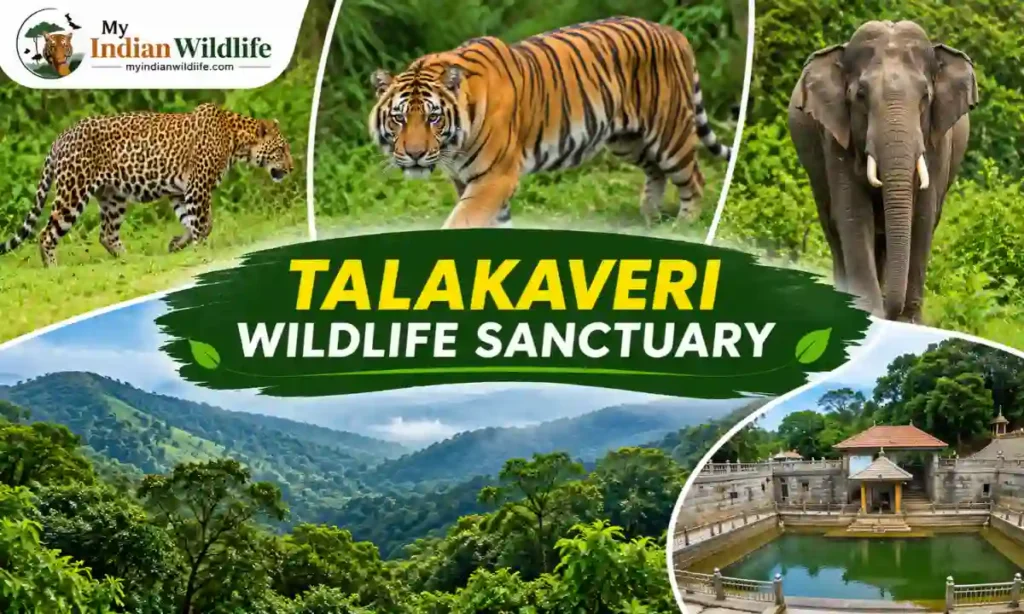
Talakaveri Wildlife Sanctuary is among the important wildlife conservation sites in Karnataka state, located in the picturesque Kodagu district of the Western Ghats. The sanctuary is well-known for its dense tropical evergreen forests, abundant biodiversity, wildlife and natural scenic mountain terrains. It is a significant part of the Western Ghats ecology and serves as a safe habitat for many rare and endangered species.
Talakaveri Wildlife Sanctuary covers an area of about 105.59 square kilometers and consists of tropical evergreen forests, semi-evergreen forests and shola grasslands that exist at high altitude. Due to its special geographical location and high levels of precipitation, the sanctuary has a rich flora and fauna, including mammals, birds, reptiles and other wild animals.
The sanctuary is also linked to Talakaveri, which is a holy site believed to be the source of the River Kaveri. The area around Talakaveri is famous for its religious significance, scenic views and ecology. For those who like wildlife, forest conservation, trekking and nature, Talakaveri can be a fascinating place in Karnataka state.
Talakaveri Wildlife Sanctuary Overview
The Talakaveri Wildlife Sanctuary is situated in the Western Ghats of Karnataka and constitutes an integral part of the state’s protected forests. The sanctuary was declared as a wildlife sanctuary on 31 August 1987 under the Wildlife Protection Act of 1972. The total area of the sanctuary is around 105.59 sq km.
| Particulars | Details |
|---|---|
| Name | Talakaveri Wildlife Sanctuary |
| Location | Kodagu district, Karnataka |
| State | Karnataka, India |
| Region | Western Ghats |
| Established | 1987 |
| Total Area | 105.59 sq. km |
| Nearest Major Town | Madikeri |
| Famous For | Evergreen forests and biodiversity |
| Major Vegetation | Tropical evergreen and semi-evergreen forests |
| Important River | Kaveri |
| Mountain Landscape | Brahmagiri Hills |
| Best Time to Visit | November to March |
Location of Talakaveri Wildlife Sanctuary
This sanctuary is located on the western region of Kodagu district, which falls under the state of Karnataka. Talakaveri Wildlife Sanctuary is a sanctuary located in the Western Ghats, which is famous for its amazing natural scenery and biodiversity. This sanctuary is enclosed by the forested hills, valleys, streams, and dense vegetation.
Geographically, this sanctuary is very environmentally important because Western Ghats get a lot of rainfall and are home to a lot of flora and fauna. The forest region of the sanctuary also plays an important part in the formation of Kaveri River watershed.
One of the main towns from where one can take a trip to Talakaveri Sanctuary along with its other places of interest is Madikeri. One more important place near the sanctuary is Bhagamandala.
History of Talakaveri Wildlife Sanctuary
The Talakaveri Wildlife Sanctuary came into existence in 1987 for the purpose of protecting the natural forests and the wildlife of Western Ghats. This place was acknowledged for its ecological value especially the natural vegetation, abundant rainfall, variety of wildlife and natural water sources.
The creation of the sanctuary served the purpose of establishing a protected area for the conservation of the natural habitat of the area. The forests of the sanctuary serve as the shelter and food sources for many animal species.
Through years of conservation, there have been many efforts made for the protection of the endangered wildlife and forests in order to avoid any kind of damage to natural habitat of the area. The sanctuary is associated with other forest areas such as Pushpagiri and Brahmagiri Wildlife Sanctuaries of the Western Ghats.
Geographical Features and Climate
The geographical landscape of Talakaveri Wildlife Sanctuary is marked with steep mountain slopes, hills covered with forests, valleys and high-altitude grasslands. The height varies approximately from 64 m to 1,659 m above the sea level. Thus, various environmental zones have been created where different flora and fauna live.
About 85% of the land of the sanctuary has steep slopes and mountainous terrain. The area is quite wet, with some parts receiving about 6,000-7,000 mm of precipitation per year. This creates favourable conditions for rich tropical flora and water bodies, which provide the rivers in the region.
The climate is rather humid during most part of the year. Monsoons bring rains and make the forest landscape green. In winter, the climate is more suitable for sightseeing. Summer is hotter compared to other seasons.
Flora of Talakaveri Wildlife Sanctuary
Talakaveri Wildlife Sanctuary is recognized for the great variety of plants that grow there. The forest environment primarily comprises tropical evergreen forests, semi-evergreen forests, shola forests, and grasslands, found at a high elevation. Such diverse forest ecosystems help to sustain various types of plants like trees, shrubs, climbers, bamboo and medicinal plants.
Forests play an important role since they serve as a source of food and habitat for animals. The dense cover of forests helps to conserve moisture and soil.
Major Plant Species Found in the Sanctuary
Some significant plants that occur at the Talakaveri Wildlife Sanctuary are Dipterocarpus indicus, Hopea parviflora, Canarium strictum, Hydnocarpus species, Kingiodendron pinnatum and Diospyros ebenum. They constitute a part of the tropical forests’ vegetation.
In addition to that, there is vegetation such as bamboos, shrubs and climbers in the lower layer of the forests. This provides additional cover as well as food source for the insects, birds and mammals.
Importance of Forest Vegetation
Talakaveri Wildlife Sanctuary’s forest vegetation is instrumental in keeping the environment stable. The trees absorb carbon dioxide from the air and provide oxygen and help keep the temperature in check. The roots of the trees keep the soil bound and protect the mountains from soil erosion.
The forest vegetation in the region helps to maintain the water table as well as assist in the natural flow of streams. Being part of the Kaveri river catchment landscape, the forest vegetation is quite significant.
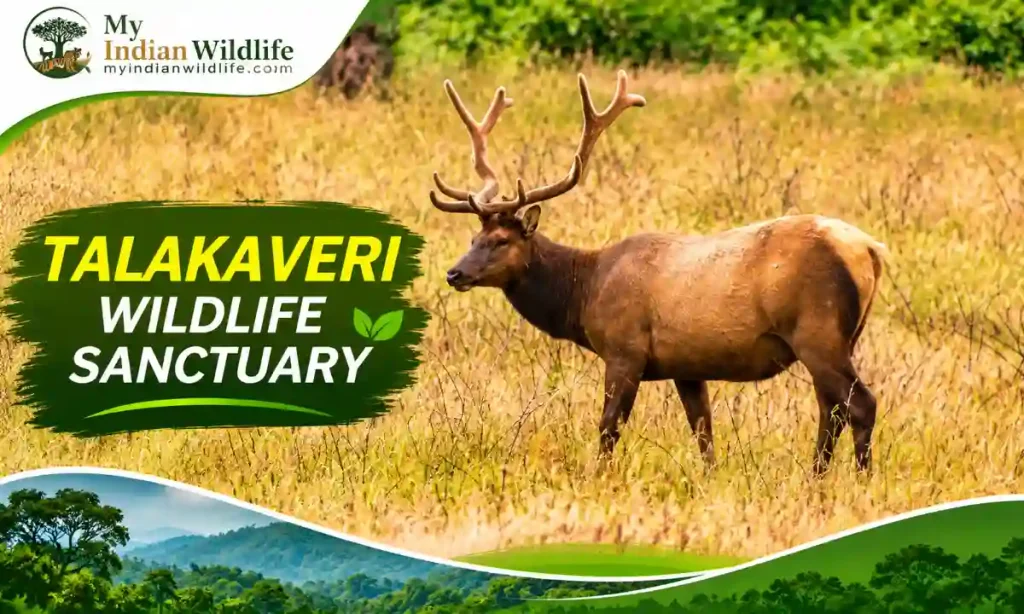
Fauna of Talakaveri Wildlife Sanctuary
There are a number of mammals living within the Talakaveri Wildlife Sanctuary, which occupies the evergreen forests, grassland and the mountains around it. Some of the mammals found within the sanctuary include big animals, predators, primates, and smaller forest animals.
The existence of different types of habitats within the sanctuary makes it a significant zone for conserving wildlife. This is because wildlife uses the forests for various activities.
Asian Elephant
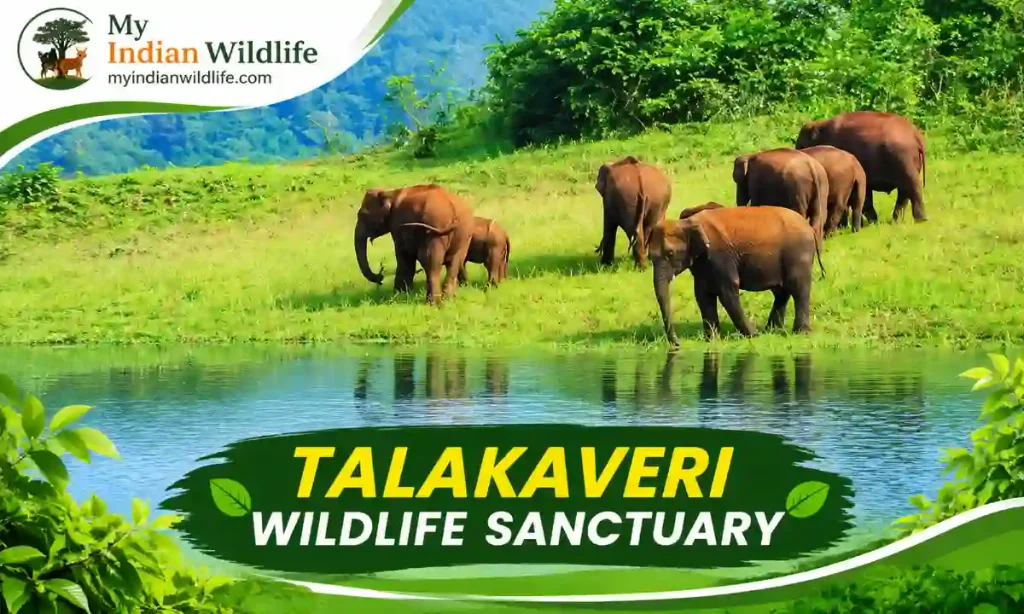
Asian elephants form one of the significant large mammals found in the Western Ghats region. Elephants require large areas of forest cover for sustenance and mobility between various sections of their natural habitat. They also have a significant role to play in the ecosystem through seed dispersion.
The forest landscape around Talakaveri forms a natural habitat for elephants and other large mammals. One must maintain adequate distance from the wildlife at all times.
Bengal Tiger
The Bengal tiger is one of the major predators of the Western Ghats area. The Bengal tiger is found at the top of the food chain in the forests. The survival of tigers depends on forest cover, availability of prey, and the absence of disturbances.
The tiger is one of the threatened animals that can be seen in Talakaveri Wildlife Sanctuary. However, visitors will not get the opportunity to see them as they are always in hiding inside thick vegetation.
Indian Leopard
Another predator that has significance for the forest ecosystem is the Indian leopard. It is a very versatile predator which is capable of living in various natural habitats.
Leopards usually stay in hiding during the day but become active in the night. They ensure that there is a balance in the ecosystem through the control of smaller mammals and other prey animals.
Lion-Tailed Macaque
Lion-tailed macaque is one of the most recognizable primates in the Western Ghats. Its body is covered in black hair, while a silver-white mane is present around the face region and it has tufted tail.
Being an endangered species, lion-tailed macaque is heavily dependent on the tropical evergreen forests. It is often found in the treetops and diet includes fruits, seeds, insects, and other natural sources of food.
Indian Gaur
Indian gaur, which is also called the Indian bison, is a large animal found in the forests and grasslands. The animal has a strong body, strong legs, and prominent curved horns.
Gaur are majorly plant eaters that eat grass, leaves, and other plants. They play an important role in the forest ecosystem due to their eating habits.
Other Mammals Found in the Sanctuary
Apart from the mentioned mammals, there are some other mammals found at the Talakaveri Wildlife Sanctuary. They include the sambar, the barking deer, the wild dog, the sloth bear, the Nilgiri langur, the slender loris, the Nilgiri marten, and the Malabar civet.
There are also small mammals such as the brown palm civet and the Travancore flying squirrel which make up for some of the animals living here.
Birds Found in Talakaveri Wildlife Sanctuary
Talakaveri Wildlife Sanctuary is equally significant as a bird habitat in the forest region. The tropical evergreen forests, semi-evergreen forests and the high-altitude grasslands provide a wide range of environments to both resident and migratory birds.
The forest canopy serves as the ideal nesting ground as well as feeding grounds to various bird species. On the other hand, the grassland areas serve to attract birds that have preferences on different vegetation regions. Bird watching in the Western Ghats area will be interesting to bird enthusiasts due to the presence of many different bird habitats.
Among the birds associated with the Western Ghats region, one may find the Malabar trogon, great pied hornbill, fairy bluebird, black eagle, Nilgiri flycatcher and the black-and-orange flycatcher.
Reptiles and Other Wildlife
The warm and humid climate of the Talakaveri Wildlife Sanctuary plays host to several reptiles, amphibians, butterflies, and insects. These smaller creatures are important members of the natural food chain and play an important role in the biodiversity of the area.
Some of the notable reptiles that live in the Western Ghats forest include the King Cobra and Indian rock python. Other amphibians find comfortable homes within the streams and forests of this wildlife sanctuary.
Butterflies and insects play significant roles in the ecosystem through processes like pollination and decomposition. Though these creatures receive far less attention than larger mammals, their significance cannot be overlooked.
Talakaveri Wildlife Sanctuary and the Western Ghats
The Western Ghats are known as one of the most significant biodiversity hotspots in the world. This is because of the vast number of plants and animals that are endemic to this particular geographical area.
The Talakaveri Wildlife Sanctuary is also part of this unique ecosystem. The evergreen forests and the shola grasslands of the sanctuary provide habitat to many endangered and endemic species.
The Talakaveri Wildlife Sanctuary also plays a role in the overall connectivity of the forests in the Kodagu region. Along with other sanctuaries like Pushpagiri and Brahmagiri Wildlife Sanctuaries, it forms a part of a larger landscape for wildlife.
Best Places to Explore Around Talakaveri Wildlife Sanctuary
There are numerous places to visit in and around Kodagu. People interested in visiting Talakaveri Wildlife Sanctuary can also visit these places to know the significance of the region.
Talakaveri
Talakaveri is one of the famous pilgrim sites located in the Brahmagiri hills. It is considered to be the birth place of River Kaveri.
The most popular tourist spot is the Brahma Kundike, a holy water body from where the river was born. There is also a temple of Goddess Kaveriamma. The hilly environment around the place adds to the charm of Talakaveri.
Brahmagiri Hills
The Brahmagiri Hills are popular for the forests found on their slopes, beautiful valleys, and mountain landscapes. The Brahmagiri Hills are famous for the bio-diversity of Western Ghats and have provided an appropriate habitat for many plants and animals.
This area is also popular among those interested in trekking in Kodagu and experiencing its natural beauty. But one must keep track of all the permissions issued by the forest department for any trekking in this area.
Bhagamandala
Triveni Sangam, which means “confluence” and is linked with three holy rivers Kaveri, Kannike, and the subterranean river Sujyoti, is one of the sacred sites situated at the place of Bhagamandala. Another place of religious significance is the Bhagandeshwara Temple situated in Bhagamandala.
The sacredness of this place along with its location near Talakaveri makes Bhagamandala a common spot among pilgrims.
Nishani Motte
Nishani Motte is one of the most famous trekking locations that can be seen amidst the forest landscape of Kodagu. This trekking track leads through some beautiful mountains and provides scenic views of the entire Western Ghats.
This place is especially appealing to those who enjoy exploring nature and trekking on mountains. As this track includes protected forest regions, the necessary bookings have to be done accordingly.
Madikeri
Madikeri is the chief township of Kodagu and also an ideal place from where one can explore the entire surrounding area. It is known for its coffee estates, cool weather, scenic vantage points and cultural activities.
One can make Madikeri as their base point for visiting other places like Talakaveri, Bhagamandala and many more places within Coorg.
Things to Do in Talakaveri Wildlife Sanctuary
The Talakaveri area offers a lot of activities that are related to the nature based tourism. The activities include wildlife viewing, trekking, bird watching and nature photography depending on the rules that apply to the conservation forest.
The forest habitat provides the opportunity to view the wild animals like elephants, deer, primates and carnivores. However, wildlife viewing should not be expected as the animals live in dense vegetation.
Trekking can also be carried out by the visitors in the area. Trails such as Nishani Motte are used for trekking and give visitors the chance to experience the beauty of the Western Ghats. It should be noted that trekking in the hills requires permission and authorization.
Visitors who are interested in bird watching should consider this activity. The sanctuary has different forest birds and various types of vegetation which will make the bird watching interesting.
Nature photography is also one of the most popular activities because of the natural environment in this area, including forested hills, misty valleys, streams and the natural vegetation. Photography regulations should be followed and animals should not be disturbed during the activity. In addition, travellers may visit authorised coffee plantations in the Kodagu region. The region
Best Time to Visit Talakaveri Wildlife Sanctuary
Talakaveri Wildlife Sanctuary is best visited from November through March. This period experiences relatively good weather and tourists get to explore other areas around the sanctuary without the trouble caused by the heavy rains during the monsoon seasons.
The winter season is particularly ideal for sightseeing and exploring. The surrounding hills are green, and the relatively favorable climate makes travel in Kodagu easier.
The summer months of March to May are relatively warmer, but the area still attracts many visitors who wish to explore the forests, temples, and coffee plantations. Travelers need to ensure that they carry enough drinking water based on the weather conditions.
The monsoon season runs from June to September. The monsoon season is characterized by heavy rainfalls in the Western Ghats. This time of year, the sanctuary becomes very green, but trekking can be challenging due to slippery trails, heavy rainfall and change in weather conditions.
Talakaveri Wildlife Sanctuary Timings
The visiting schedules for Talakaveri temple and the reserved forests differ. Visitors are free to enter the temple premises during the daytime hours, but entering the restricted forest regions will be based on the permit issued by the Karnataka Forest Department.
Travelers intending to undertake treks or forest excursions must ascertain the visiting timings at the time of traveling from the respective authorities. There can be variations in the visiting timings based on the specific routes and climatic conditions.
Visiting Talakaveri as a pilgrim site does not mean automatic authorization to visit the restricted region of the wildlife sanctuary.
Talakaveri Wildlife Sanctuary Entry Fee
The entry fees to Talakaveri Wildlife Sanctuary vary depending on the nature of the activity and the entry system used. There is no specific general entry fee that should apply to all parts of the conservation area.
Tourists visiting the Talakaveri temple site and those engaging in any other approved forest activity will need to have different considerations. Trekking permits and guide fees among others should be obtained from the forest department or eco-tourism systems approved by the forest department.
Tourists intending to embark on the Nishani Motte trek will require prior information on booking and entry fees.
How to Reach Talakaveri Wildlife Sanctuary
Talakaveri Wildlife Sanctuary lies in Kodagu district of Karnataka state. Tourists can access this area via Madikeri and Bhagamandala by road transport. The route involves traveling through hills of forests, coffee plantations and beautiful scenery of the Western Ghats range.
By Air
The visitors who arrive at the place via air can take advantage of Kannur International Airport or Mangaluru International Airport, whichever seems suitable according to the source of arrival and the road route chosen. Visitors arriving from far-off cities can use Kempegowda International Airport in Bengaluru.
Once they land at the airport, they can use road transport like taxi services to make their way to Madikeri and then proceed to Bhagamandala and Talakaveri. The distance traveled would depend upon which airport they used.
By Train
Kodagu does not have any significant railway station in Madikeri. Depending on the route taken, visitors can take advantage of railway stations like Mysuru Junction, Mangaluru Junction, and Hassan.
From these railway stations, one can complete his/her journey either by taking a taxi or by bus till Madikeri. The last leg of the journey will need road transport.
By Road
Driving by road is one of the easiest means of reaching Talakaveri. The journey can be made from Madikeri to Bhagamandala and then to Talakaveri.
Traveling by road provides a scenic view of the Western Ghats, coffee gardens, forested landscapes, and green hills. One should be careful while driving especially during monsoon season due to heavy rains.
Talakaveri Wildlife Sanctuary Location & Google Maps
Talakaveri Wildlife Sanctuary is situated in the Kodagu district of Karnataka state of India and lies in the stunning area of Western Ghats. The wildlife sanctuary is bordered by evergreen forests, lush green hills and natural diversity. The site is near Talakaveri, which is famous for its religious significance and believed to be the birthplace of River Kaveri. Travellers can visit the region by road through Madikeri and Bhagamandala. You can locate the precise position by following the map below on Google Maps.
Distance from Major Cities
There are some other significant cities and towns which are accessible by road from Talakaveri. The distances mentioned below are only approximate and might vary depending upon the destination reached.
| Starting Location | Approximate Distance |
|---|---|
| Madikeri | 48 km |
| Bhagamandala | 8 km |
| Mysuru | 140–150 km |
| Mangaluru | 130–150 km |
| Bengaluru | 280–300 km |
| Kannur | 120–140 km |
Talakaveri is easily accessible from Madikeri and Bhagamandala. It is advisable to confirm the route of your choice prior to embarking on your journey because the time taken on the road varies.
Accommodation Near Talakaveri Wildlife Sanctuary
The visitors who want to visit the Talakaveri Wildlife Sanctuary will be able to stay at Madikeri, Bhagamandala and other areas in Kodagu. There are various kinds of accommodation facilities available in this area, such as hotels, resorts, guest houses, and homestays.
Madikeri would be among the most convenient options for the accommodation of the visitors because there are many tourist destinations that visitors can easily access from here. The visitors will be able to have various accommodations at different price ranges.
Bhagamandala is also an option for the visitors who want to stay close to the religious sites of Talakaveri. The accommodation facilities would be less than those found at Madikeri, hence, advanced planning is necessary.
Accommodations at coffee estates are also common in this region. Such kind of accommodation facility gives visitors an opportunity to experience plantation surroundings. Travellers need to make sure about these aspects before booking their rooms.
Travel Tips for Visiting Talakaveri Wildlife Sanctuary
Preparations are needed before visiting the Talakaveri Wildlife Sanctuary since the place has difficult terrains, thick forests and high rainfall areas. Having comfortable clothes and shoes can make visiting and trekking easy.
One needs to be aware about permissions from the forest department before visiting any restricted areas. It is not assumed that every path in the forests is accessible to people. It is recommended to follow the guidelines to ensure safety.
Water, rain cover and basic supplies are always needed when visiting the area. Weather in Western Ghats is known to change suddenly, especially during the monsoon season. One also needs to know about the road and weather conditions before traveling.
Visitors should never feed wild animals, make too much noise or leave plastic waste in the forest areas. This is necessary to ensure protection of nature.
Wildlife Conservation and Environmental Importance
Talakaveri Wildlife Sanctuary is a vital component of the Western Ghats ecosystem. This place is home to evergreen forests, semi-evergreen vegetation and shola grasslands, which serve as a habitat for several species of flora and fauna that are endangered and endemic.
These areas house several important mammalian species, including elephants, tigers, gaurs, sambars, lion-tailed macaques, and others. The conservation of these species depends on providing them with appropriate habitats and ensuring food and water sources.
It is worth noting that this protected area has high hydrological significance due to its role in providing a habitat in the Kaveri river catchment. Forest vegetation provides important regulatory functions for water flow, prevents soil erosion, and ensures proper water quality in the streams.
One more reason for the conservation of this place is that many plants and animals here are endemic to the Western Ghats region. Therefore, conservation of Talakaveri’s forest ecosystem will help preserve natural biodiversity of India.
Rules and Regulations for Visitors
While visiting Talakaveri Wildlife Sanctuary, tourists need to abide by the rules made by the forest authority. Any form of hunting, catching or hurting of wild animals is not allowed, and tourists are supposed to avoid interfering with the wild animals such as the birds.
One needs to avoid entering the forest areas that have been closed to the public. Travellers need to adhere to the specified paths by the forest officials. During treks, tourists should move with the authorized guides where necessary.
Activities like littering, making unapproved fire and collecting plant life can harm the forest ecosystem. Tourists need to carry away all their waste and avoid any activities that interfere with the natural habitat.
Photography is also expected to be carried out responsibly. Flash photography, loud noise and trying to get close to wild animals can be very harmful to wildlife.
Is Talakaveri Wildlife Sanctuary Worth Visiting?
It would be worthwhile to visit Talakaveri Wildlife Sanctuary for those who wish to know about the natural forest, biodiversity, wildlife conservation, and beauty of Western Ghats. The evergreen flora, mountainous terrain, and abundant wildlife of this place make it a noteworthy ecotourism site in Karnataka.
There is much to know about the Talakaveri Wildlife Sanctuary due to its association with the Kaveri river basin and Western Ghats region. Travelers may also pay a visit to other places like Talakaveri, Bhagamandala, Brahmagiri Hills, and Madikeri while visiting the sanctuary.
Nevertheless, tourists who seek wildlife safaris or wildlife sightings should be aware that Talakaveri is actually a natural forest reserve. Access to some parts of this area is restricted and wildlife sighting depends on natural circumstances.
In general, Talakaveri Wildlife Sanctuary is a significant destination where visitors can learn about natural beauty, wildlife diversity, and the importance of conservation in the Western Ghats of Karnataka.
Interesting Facts About Talakaveri Wildlife Sanctuary
There are various unique features of Talakaveri Wildlife Sanctuary that make this sanctuary a significant protected site in Karnataka. One of the most important things is the fact that this sanctuary got declared as a wildlife sanctuary in 1987 and is spread over 105.59 square kilometers.
This sanctuary forms a part of the Western Ghats which is known for its high levels of biodiversity and endemism. The sanctuary has tropical evergreen forests, semi-evergreen forests, and shola-grasslands.
One of the most unique things about this sanctuary is its connection with Talakaveri, the religious place believed to be the source of River Kaveri. The surrounding forests help in forming the catchment system of the river and help form natural sources of water.
Another unique thing about this sanctuary is that it houses various threatened species like tigers, Asian elephants, lion-tailed macaques and Nilgiri martens. It also provides various habitats to these species due to its rugged topography and high rainfall levels.
Another important feature of Talakaveri is that it has strong ecological connections with other protected forest areas of the region like Pushpagiri and Brahmagiri Wildlife Sanctuaries.
Conclusion
Talakaveri Wildlife Sanctuary is one of the key conservation sites in Karnataka and is notable because of its biodiversity, evergreen forest, mountainous terrain and ecological significance. The wildlife sanctuary, which is located in the Western Ghats in Kodagu, is known to provide shelter for many mammals, birds, reptiles and plants.
The significance of Talakaveri Wildlife Sanctuary in association with the river Kaveri makes it ecologically significant as well as religiously important. The presence of endangered animals, rich vegetation and natural water resources makes it evident that the conservation of this forest eco-system is necessary.
From a nature lover and tourist perspective, who wants to explore Coorg, visiting the Talakaveri Wildlife Sanctuary gives them the opportunity to learn about the beauty of the Western Ghats. It is imperative that the tourists practice responsible tourism and conservation of the forest eco-system.
Faqs
Where is Talakaveri Wildlife Sanctuary located?
Talakaveri Wildlife Sanctuary is located in the Kodagu district of Karnataka, within the Western Ghats of South India. It is situated on the western side of the district and is surrounded by forest-covered hills and valleys.
When was Talakaveri Wildlife Sanctuary established?
Talakaveri Wildlife Sanctuary was officially notified on 31 August 1987 under the Wildlife (Protection) Act, 1972. It was established to protect the region’s natural forests and wildlife.
What is the total area of Talakaveri Wildlife Sanctuary?
Talakaveri Wildlife Sanctuary covers approximately 105.59 square kilometres. Its landscape includes tropical evergreen forests, semi-evergreen forests and high-altitude grasslands.
Which animals are found in Talakaveri Wildlife Sanctuary?
The sanctuary provides habitat for several mammals, including Asian elephants, tigers, leopards, Indian gaurs, sambar deer, barking deer, lion-tailed macaques, wild dogs and Nilgiri martens.
What is the best time to visit Talakaveri Wildlife Sanctuary?
November to March is generally considered a suitable period for visiting the region. During these months, the weather is comparatively pleasant, making sightseeing and outdoor exploration more comfortable.
Is Talakaveri Wildlife Sanctuary famous for the Kaveri River?
Yes, the sanctuary is closely associated with Talakaveri, the sacred place traditionally considered the origin of the Kaveri River. The surrounding forest landscape also contributes to the river’s catchment system.
Is trekking allowed in Talakaveri Wildlife Sanctuary?
Authorised trekking activities are available in the surrounding forest landscape, including routes such as Nishani Motte. Visitors must obtain the necessary permissions and follow the regulations established by the forest department.
What is the nearest major town to Talakaveri Wildlife Sanctuary?
Madikeri is the nearest major town and a convenient base for exploring the Talakaveri region. Bhagamandala is another nearby destination that provides access to the Talakaveri pilgrimage area.
Are tigers found in Talakaveri Wildlife Sanctuary?
Yes, tigers are among the important wildlife species associated with the sanctuary. However, visitors should not expect guaranteed sightings because tigers generally remain hidden within forest habitats.
Is there an entry fee for Talakaveri Wildlife Sanctuary?
Entry charges depend on the type of activity and the applicable access arrangements. Visitors planning trekking or authorised forest activities should confirm current fees and permissions with the forest department.
Which river originates at Talakaveri?
The River Kaveri originates from a sacred spring at Talakaveri in the Brahmagiri hills of Karnataka. The location is an important pilgrimage destination for devotees.
Can families visit Talakaveri Wildlife Sanctuary?
Families can visit the accessible Talakaveri pilgrimage area and nearby tourist attractions. However, entry into restricted forest areas depends on permissions, route conditions and visitor regulations.
Why is Talakaveri Wildlife Sanctuary important?
Talakaveri Wildlife Sanctuary is important because it protects tropical forests, threatened wildlife and the biodiversity of the Western Ghats. Its forest ecosystem also contributes to the water resources of the Kaveri river basin.
Also,Read About: Wildlife Sanctuary Delhi: Asola Bhatti Wildlife Sanctuary, Timings, Ticket Price, Animals & Complete Travel Guide